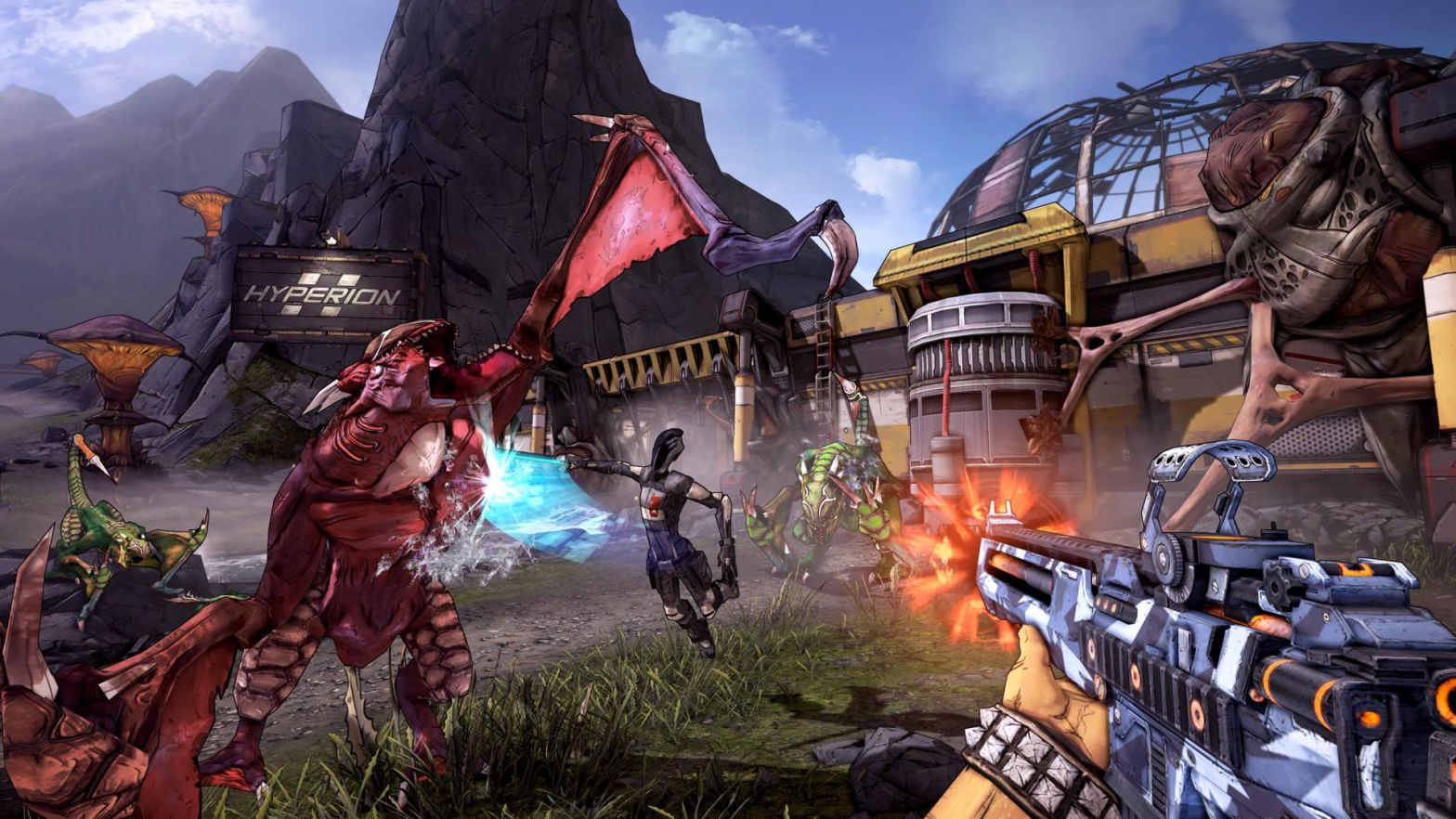
On my crusade through the Borderlands games, I have finally finished Borderlands 2 and the Tiny Tina DLC! It’s been a marathon of FPS gaming that I haven’t experienced before. I may be slow compared to a lot of gamers, but I went through Borderlands 2 rather quickly for my average.
Ch-ch-ch-changes!
Although most of the gameplay is still the same loot’n’shoot that made the first game so great, the second made some changes that were daring, but not my favorite. Consolidating revolvers and repeaters into one category did make collecting and buying rounds easier and more straightforward, but it did mean you had one less place to turn if you ran out of all other ammo types.
A major negative change, in my opinion, comes from the decision to eliminate weapon proficiencies. Sure, it makes it easier for any player to pick any character, choose any weapon and get into the game, but I miss the original way. Anyone could still pick whatever and start playing, but those who paid attention (which admittedly wasn’t me most of the first game) could still take more of an advantage of the proficiencies while newcomers were never restricted from playing without paying attention to stats. It’s a small thing to nitpick about, but choosing one character over another mattered a lot more back then.
“Turret Out!”
I played through as Axton, and as such, threw down an awful lot of sabre turrets. I took every perk down the survival section of the skill tree, and will probably explore more of the other perks as I march through the DLC.
This brings me to a complaint about the game that was worse in this game than the first. Why does your character get stuck on stuff so much? Sure, maybe it’s not something developers iron out as heavily as other aspects of gameplay, but I was disappointed by how frequently I would just become unable to move and not know why. Sometimes it was a tiny change in elevation, an uneven staircase, a distant corner of your own sabre turret, or an invisible wall. Sometimes I was walking backward and thought corridors were longer than they should be. That last one’s on me, but the others happened a lot more frequently than I thought they should. Still, that kind of disconnect from my immersion was a constant frustration.
Character Writing in Gaming
The biggest plus to Borderlands 2 is the writing. In just about every way, the writing improves. From dialogue, to plot, to character development, Borderlands 2 is probably the game hundreds of other games have looked back to as an example of well-written character dialogue. Of course, it wasn’t well-written in a profound prose sense, but rather in an expressive sense.
Every time Handsome Jack opened his mouth, it gave you another reason to hate him. Romantic tension between Roland and Lilith was real, Mordecai got a personality, and Claptrap became a lovably annoying little thing that wasn’t derivative of a million other robot sidekick characters in science fiction. Tiny Tina played a smaller role in the game than she deserved, especially given the subtext her quests hint at.
Conclusion
In the end, the greatest writing in the world does not forgive bad gameplay. That’s not to say that Borderlands 2 had bad gameplay, but it did feel like a downgrade from the first game. Its more balanced ramp of difficulty would save it, if the battle against the Bunker wasn’t such an unreasonable jump. The threat of losing money from respawning was more real, but at the same time, the need for in-game money was far less important. As enjoyable as the character dialogue, and voice performances are, they don’t make up for what was lost in gameplay.
Still, it’s a wonderful game that any RPG or FPS player should experience.
I give Borderlands 2 for the PlayStation 4 (Via the Handsome Collection) an 8/10.
Welcome to Pandora, Kiddos!
 The Phyronian Chronicle